Grandparents and Little Ones · Experiment 3 of 3
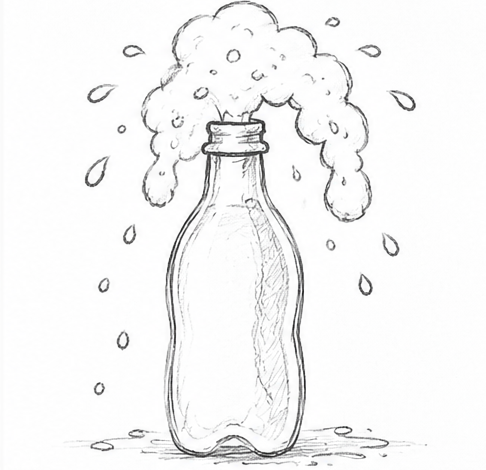
Atoms swap partners — and become something completely new.
What to do — make a volcano in your kitchen
You will need: a tall glass (such as a beer glass) or bottle · bicarbonate of soda · vinegar · a teaspoon · a tray or bowl to catch the overflow · a balloon (for the big surprise!).
Safety: Do this on a tray — it overflows enthusiastically and that is entirely the point. If you add a drop of washing-up liquid it will foam even more dramatically. If possible, you have been warned. You might want to do this experiment outside.
- Allow the little ones feel temperature of the glass or bottle. It should be at room temperature. Put two heaped teaspoons of bicarbonate of soda into the glass. Let the little one do this — it looks completely harmless and boring. Good.
- Now pour in a good splash of vinegar. Stand back and watch the glass erupt! The fizzing is violent, fast, and extremely satisfying. You can first add a bit of food colouring (say red) to the vinegar. It makes it even more fun.
- Once the excitement has settled, touch the glass. It will feel slightly cooler than it did — the reaction used up some heat from the glass itself.
- The balloon trick: put two teaspoons of bicarbonate inside a dry balloon. Pour vinegar into a bottle. Stretch the balloon over the bottle neck without letting the bicarb fall in yet. When ready, lift the balloon so the bicarb falls into the vinegar — and watch the balloon inflate all by itself, with nobody blowing.
For grandparents to explain
In Experiments 1 and 2 we learned that everything is made of atoms and molecules, that atoms are always moving, and that atoms have positive (+) and negative parts (-) (or charges) that can be pushed around. Now we discover something even more remarkable: when certain substances meet, their atoms do not just push each other around — they completely swap partners and become entirely new substances that did not exist before.
Imagine two pairs of friends who have always walked together. Suddenly they meet, decide they want to walk with a person from the other pair, swap partners entirely, and walk off in two completely new pairs. The same four people are now arranged differently. That is a what the chemical reaction looks like.
Vinegar is an acid — its molecules are eager to react. Bicarbonate of soda is an alkali — its molecules are equally eager. When they meet, the atoms swap partners so fast and so enthusiastically that one of the new substances formed is carbon dioxide gas. Gas takes up far more space than liquid, which is why it erupts out of the glass so dramatically. The fizzing is not the vinegar and bicarb mixing. It is brand new gas being born.
Carbon dioxide is also what you breathe out with every breath. It also makes the bubbles in fizzy cool drinks. It is what most fire extinguishers spray. In about one second the same gas is made in your kitchen from two completely harmless kitchen ingredients.
The glass feeling cool afterwards is a clue that something real happened. The reaction needed energy to rearrange all those atoms, and it borrowed that energy as heat from the glass and the air around it. Reactions that take in heat are called endothermic — which simply means heat-absorbing. The cold feeling is the reaction doing its work.
The balloon inflating by itself is the same reaction, just trapped. The carbon dioxide gas has nowhere to escape so it pushes into the balloon instead. A balloon inflated by a chemical reaction rather than a pair of lungs. A rocket engine, a rising loaf of bread and a fizzy drink, all work on the same principle.
Something big to think about together: Plants breathe in carbon dioxide and breathe out oxygen. We breathe in oxygen and breathe out carbon dioxide. We are doing opposite jobs, and we need each other to survive. The gas your little volcano just made is the same gas every plant around you is quietly drinking in right now — and turning into leaves, and roots, and flowers, and eventually into the food on your table. The same atoms, moving through the world in an endless circle. That circle has been turning for four billion years, and it is turning right now, in your kitchen, in a glass on a tray.
Well-done children – you have just done real science.