It is a Saturday morning in Vernoeg. Mark has been visiting with the children since Thursday. Celia’s house has been temporarily overtaken by a six year old, a four year old, and a baby who has something to say about everything. Augusta has come to Johana’s stoep for refuge after visiting the family..
Augusta arrives, as she has been doing on and off for sixty-three years and sees no reason to stop. She comes through the gate, past George in his knitted coat, who is watching proceedings from his usual post with his usual expression of mild contempt, past Mildred, who doesn’t look up, and drops into the chair opposite Johana with the air of someone who has something to say.
Johana is sitting on the stoep stairs enjoying the early morning sunshine. Dressed in her old dress, the faded flowered one she wears when she has no plans and no apologies about it. Themba is at her feet. Cleo is on the wall in a position of maximum inconvenience. The chalkboard says what it always says on Saturdays.
Walk the dogs.
Chat with the meerkat.
Argue with the dassie.
Repeat.
“You can’t just sit here,” says Augusta.
Johana looks at her.
“I’m not just sitting. I’m having coffee.”
“You’re sitting on the stoep talking to animals.”
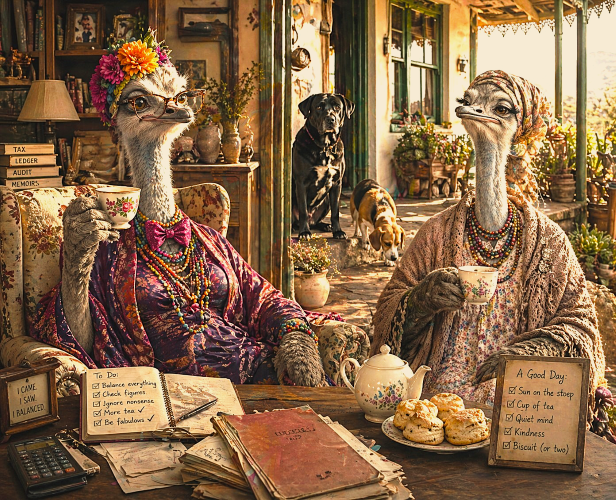
Johana looks at Themba. Then at George. Then at Mildred. Then back at Augusta.
“Yes,” she says.
Augusta straightens her flower crown.
“You need a purpose. Something to do. Something that matters. You can’t just… sit.”
Johana is quiet for a moment, the way she is quiet when she is allowing Augusta to hear herself.
“Augusta,” she says finally, “you walked here from your house. Did you talk to Charlie on the way?”
“That’s different. He expects it.”
“Did you talk to Winnie?”
“Winnie was investigating something in the garden. I may have commented on it.”
Johana picks up her coffee.
“So you walked along the street talking to animals to tell me I shouldn’t sit on my stoep talking to animals.”
Augusta opens her mouth.
Then closes it.
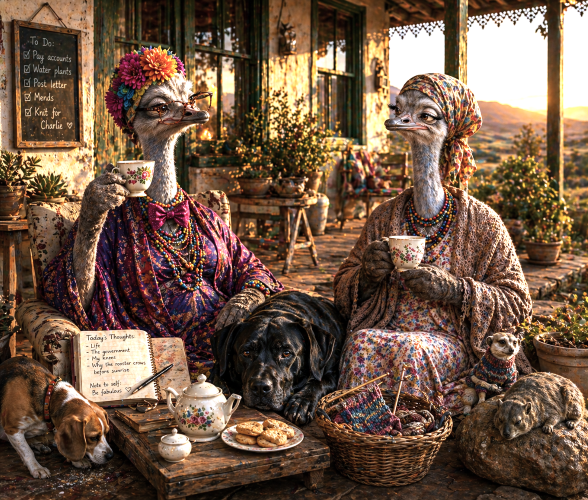
The Karoo morning does what it does—the light shifting, a pigeon cooing somewhere, the mountains ever-changing and unhurried in the distance.
“Mama used to say,” says Johana, “that the devil finds work for idle hands.”
“She did,” says Augusta.
“She said it to us constantly. And then she spent the last twelve years of her life sitting on the stoep drinking tea.”
Augusta looks at her hands.
“She did.”
“And she was,” says Johana carefully, “not unhappy.”
“No,” says Augusta. “She was not unhappy.”
They sit with that for a moment. Two sisters on a stoep in the town where they were born, becoming their mother in the morning light, and finding it is not the worst thing they have ever become.
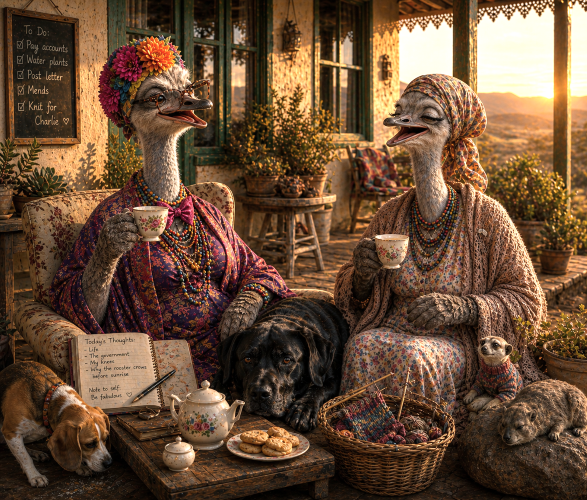
Then Johana starts laughing. It begins as a smile and becomes something more, the kind of laugh that comes from somewhere old and true. Augusta watches her for a moment with great dignity before she gives in to it completely. The flower crown tilts. Augusta doesn’t fix it.
The children are still at Celia’s after lunch. Mark is fixing something in the garden that Hugh never got around to. Celia appears at Johana’s gate looking like a woman who has been loved very thoroughly all morning and needs twenty minutes of quiet.
“Take Biscuit out,” says Johana. “Augusta will go with you.”
“I will,” says Augusta, in the tone of someone who has just decided this.
Augusta takes the lead because Augusta always does, and Biscuit trots alongside her with the slightly uncertain air of a dog who is used to a more measured pace. They all forget that Biscuit is Celia’s dog. That is the way it is with Augusta.
They go down the main street, past the co-op, past the church, past the house where the Jouberts have been meaning to paint the gate for three years, but have replaced the roof the wind blew off, and out towards the edge of town where the road begins to think about becoming the veld.
“Biscuit,” says Augusta, when Biscuit investigates something that doesn’t need investigating.
Biscuit ignores her.
Augusta and Celia walk.
They are quiet.
Celia is tired after the energy of the children and simply enjoys the silence. Augusta thinks the way she always thinks—in straight lines, moving from one point to the next, not stopping until she has arrived somewhere.
Augusta stops.
Biscuit stops.
Celia continues walking, seeing nothing, hearing nothing, wrapped in her memories of Hugh.
It sits on the edge of the main road where it has always sat—a low building, whitewashed once, the paint peeling now in patches in the particular way of Karoo buildings that have been left to manage alone in the heat.
The wooden sign above the door is still there.
The shelf beyond the window, where the preserves used to sit, is empty.
The little hand-painted board that used to list the specials has blown sideways, and nobody has straightened it.
Augusta looks at the building for a long time.
Biscuit eventually sits down beside her and looks at it too.
Then Augusta straightens her flower crown, shortens the lead, and walks faster to catch up with her friend.
“What was that?” asks Celia.
“Nothing,” says Augusta.
They turn and head back towards town.
Augusta doesn’t say anything about it.
Not yet.
Celia hasn’t seen it.
Not yet.
That evening Augusta sits on her own stoep with Charlie at her feet and Winnie arranged hopefully beside the biscuit tin. She thinks about idle hands and purpose, and what her mother would have said about a woman with forty years of accounting behind her sitting on a stoep in Vernoeg doing nothing in particular.
She picks up her phone.
Not to talk about the padstal.
She is not ready to talk about the padstal yet.
Just to talk.
“Johana,” she says when her sister answers. “Are you busy?”
“I’m arguing with the dassie,” says Johana. “It’s on the schedule.”
Augusta smiles.
“Come for supper. I’ll make something.”
“You’ll make cinnamon toast,” says Johana. “You always make cinnamon toast when you’re thinking.”
“I’m not thinking,” says Augusta.
“Seven,” says Johana. “And I’ll bring something that isn’t toast.”
Augusta puts the phone down and looks at Charlie.
Charlie looks back with the expression of a dog who has eaten Augusta’s toast and has views about it..
Next time: A purpose.
Booklet: Some thoughts on: Managing Death and Retirement