Grandparents and Little Ones · Experiment 1 of 3
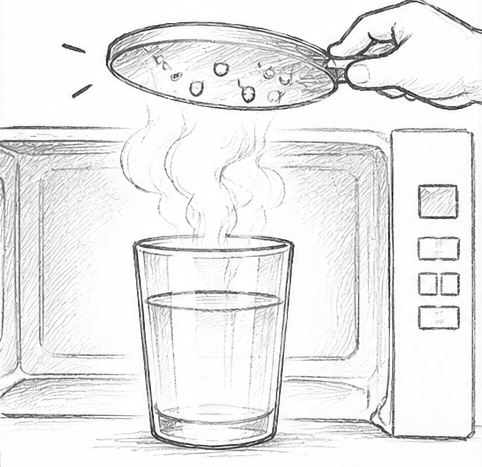
What to do — watch the water dance
You will need:
- a microwave
- a microwave-safe glass or mug
- water
- a lid or cold dry side plate
Safety: The grandparent handles the microwave and the hot water. Little ones watch, touch the cool condensation, and ask the questions.
- Fill the glass about halfway with cold water and place it in the microwave.
- Heat it for one to two minutes until you can see steam rising. If you can, watch through the microwave door together — what can you see happening?
- Carefully remove the glass. Hold a cold dry side plate just above the steam for a few seconds. Watch tiny water drops appear on the plate from nowhere.
- Let the little one touch the drops on the plate — they are just warm water. Ask: where did they come from? The plate was completely dry a moment ago.
- Do the same experiment again but place an empty mug in the microwave as well.
- Now ask: why did the water get hot — but the empty mug next to it stayed cool? This is the big clue.
For grandparents to explain
Water is made of tiny, tiny things called molecules — each one so small that a single drop of water contains more of them than there are stars in the sky. You cannot see them, but they are always moving — bumping into each other, bouncing around, never completely still.
Think of a school playground at break time. Hundreds of children running, bumping, changing direction. That is what the molecules in water are doing, all the time, even in a glass sitting quietly on a table. Cold water is a calm playground. Hot water is an extremely excited, busy one with lots of activity.
A microwave oven does one very special thing: using invisible waves (microwaves) it excites water molecules. It makes water molecules spin and vibrate faster. The faster they move, the hotter the water gets. Heat is not a thing that goes into the water — heat simply is the movement of those molecules bumping into each other as they get excited and move around. More movement means more heat. That is all heat ever is, anywhere.
Rub your hands together quickly. They get hot from the rubbing movement. The more you rub the hotter they will get.
This is why the empty mug stays cool — it contains almost no water molecules, so the microwave has nothing to excite. And it is why food in a microwave defrosts unevenly — the ice crystals do not respond to microwaves the way liquid water does. Only the parts that have already begun to melt get hot quickly.
Atoms that cluster together – either the same type or different types are called molecules. When the water gets hot enough, some molecules at the surface are moving so fast they escape into the air entirely — that is steam. When that steam touches the cold plate, it slows down suddenly, loses energy, and turns back into liquid water drops. The molecules did not disappear — they just changed from an excited, free-flying state back into a calmer, closer-together state.
Steam turning back to water on a cold surface is the same thing you see on a bathroom mirror after a hot shower, or on a cold drink glass on a hot day, or on your spectacles when you come inside from the winter cold. Same molecules, same process, happening all around you every day.
Something to think about together: If heat is just molecules moving fast, what do you think cold actually is? Not a thing that comes in from outside — but simply molecules that are moving slowly and quietly. In fact, there is no such thing as cold, really. There is only less heat. On the coldest night of a Highveld winter, the molecules in the air are still moving — just much more slowly than on a hot summer afternoon in December.
Next: Experiment 2 — The magic comb · When atoms have parts that can be pushed around