
Maggie arrives on a Tuesday in hired a small white car that she drives with the same focused efficiency she brings to everything. She has four weeks, a plan, and a bag that is almost entirely practical except for one worn paperback at the bottom that she has been carrying since her undergrad years and never quite finished.
“She’s here,” says Johana from her stoep. Augusta is inside telling Winnie she has already have breakfast and not to eat Themba’s.
The small white hire car parks outside Celia’s gate with precision. The door opens and a tall young woman gets out — Hugh’s height, Hugh’s cheekbones, Celia’s eyes — and stands for a moment looking at the house. Then she picks up her bag and goes through the gate without hesitating.
Augusta appears at Johana’s gate within moments.
“Well,” says Augusta.
“She looks like Hugh,” says Johana.
“She moves like Celia,” says Augusta. “Which is more useful.”
They give it until the next morning. Johana knows better than to arrive the first evening — that time belongs to Celia and Maggie alone.
They arrive at ten with beskuit and the good coffee, and Johana knocks in the way she has knocked on that door for thirty years, two short and one long, and Maggie opens it.
“Johana,” says Maggie, and her voice does something complicated.
Johana takes her face in both hands the way she has been doing since Maggie was three years old. “Let me look at you. You’re thin. Are they feeding you in Norwich?”
“It’s England,” says Maggie. “They try.”
“Augusta,” says Johana, “this is Maggie. She grew up in that room on the left.”
“I know who she is,” says Augusta. “She has her father’s nose. Come inside.”
Celia has not given away anything she’ll regret. She has, however, allowed Maggie to reorganise the sorting system, which now has five categories instead of three and a colour-coded labelling arrangement that Augusta regards with deep suspicion.
“It’s a lot of labels,” says Augusta.
“It helps to have a system,” says Maggie, from the dining room.
Augusta looks at Johana. Johana looks at Augusta.
“Tell me about genetic crop manipulation,” says Augusta.
Maggie blinks. “It’s — not what most people ask about.”
“I’m not most people,” says Augusta. “Tell me.”
And Maggie tells her. About drought-resistant varieties and soil microbiomes and the work being done to adapt crops to a changing climate. She talks the way people talk when they are given unexpected permission to care about something out loud. Her hands move. Her eyes are focused.
Augusta listens with complete attention.
“This work,” says Augusta when Maggie pauses. “Could it be done here? In the Karoo?”
Maggie looks at her. “There’s actually significant need here. The farmers are under enormous pressure. Water, climate, costs. The co-op has been asking—” She stops. “Yes. It could be done here.”
Augusta says nothing. She picks up her tea. She does not look at Johana.
The Cape Town conversation happens that afternoon. Maggie lays it out clearly to Celia and her friends — the property listings, the proximity to Mark, the quality of life score, the medical facilities. It is a good presentation.
“It makes sense on paper,” says Augusta when Maggie finishes.
Maggie looks at her, slightly surprised to find agreement where she expected resistance.
“On paper,” says Augusta. “Your mother doesn’t know anyone in Cape Town. Mark has his own busy life. Starting over socially at sixty-four is harder than a quality-of-life score can measure.”
“Maggie,” says Johana gently. “Do you remember Mrs Rousseau? She lived on the corner of Kerk and Main.”
Maggie frowns. “Vaguely. She moved away.”
“To Johannesburg,” says Johana. “To be near her son. It was a shame. He moved to Australia eight months later.”
Maggie is quiet.
On her last evening Maggie sits on the stoep with Celia after Augusta and Johana have gone home. The mountains do their purple thing at dusk. A hadeda announces itself. Charlie takes up most of the floor. Winnie is asleep against Maggie’s feet.
“I forgot,” says Maggie quietly.
“What?” says Celia.
“This,” says Maggie. “The evenings. The quiet. The way everything goes that colour.”
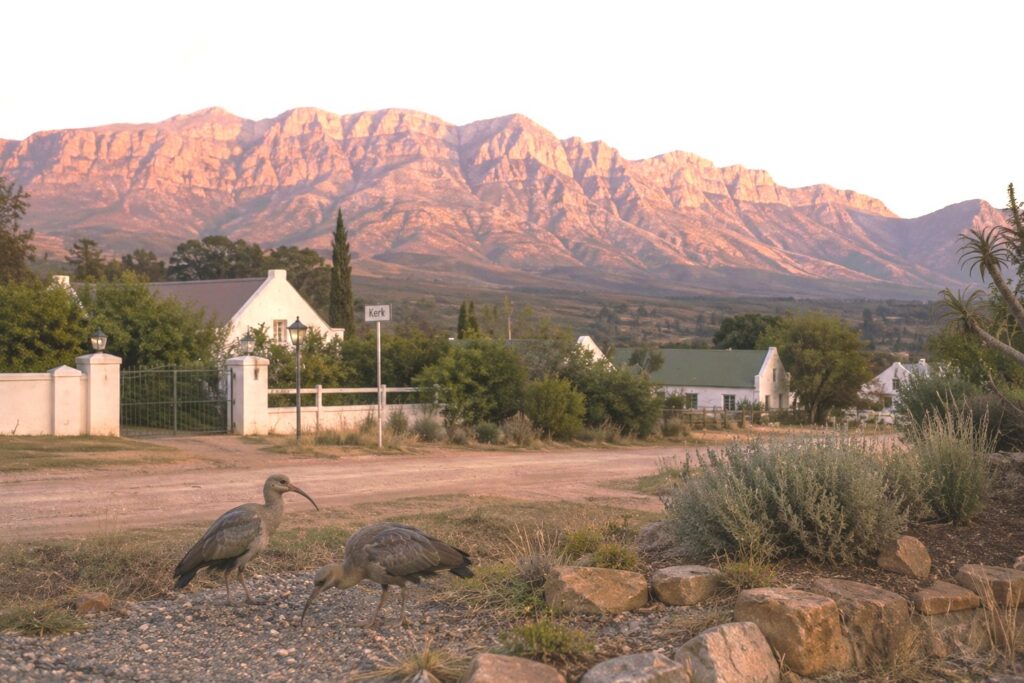
Celia looks at the mountains. “Yes.”
“I didn’t think I’d understand why you’d want to stay.”
“Do you understand now?”
Maggie is quiet for a long moment. “I think I’m beginning to,” she says.
Over the next few weeks the Cape Town spreadsheet is not mentioned again. Instead Maggie goes out to see people that matter. At the end of week she returns to Norwich. Reluctantly. To do work that matters. To see people who matter.
Next time: The spat and idle hands.
Booklet: Some thoughts on: Managing Death and Retirement