It is a Tuesday morning in Vernoeg.
The exercise is done—the Karoo ladies in the golden light, arms outstretched, the mountains watching, George, the meerkat performing his own version in the background. Afterwards they all settle on Augusta’s stoep with tea and the particular satisfaction of people who have done something good for themselves before the day has properly begun.
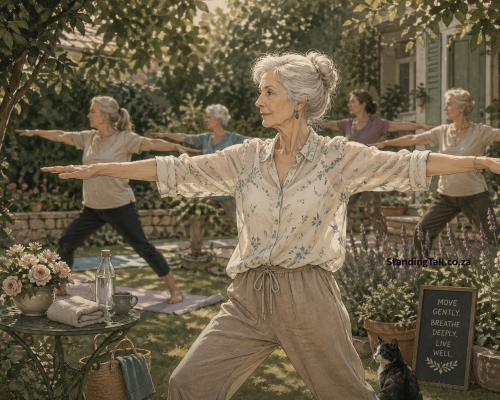
Johana pours. Celia, with her blonde white hair in a pony tail, is still slightly pink from the exertion, which suits her. Nell, who leads the exercise class looks as cool and self-contained as always, Augusta sits to one side and is already making a list of what the padstal courtyard would need if they were to do this properly—a level surface for tables, some shade, perhaps a bougainvillea against the wall. She has not shared these thoughts yet. They are still in the planning stage.
Nell sits with her tea and looks at the mountains. She does this in the unhurried way of someone who has looked at mountains all her life and still finds them worth looking at.
“It’s good to have something to look forward to on a Tuesday morning,” says Johana, to no one in particular.
“Mm,” says Augusta.
“Mm,” says Celia.
Nell says nothing.
Which is not unusual.
But the quality of her silence is slightly different this morning, and Johana, who has been reading silences on this stoep for decades, notices it and quietly files it away.
The others leave in their own time. Augusta has figures to calculate. Celia has sorting to do—there is always sorting to do. Biscuit goes across the road with Celia to lend moral support.
Johana stays.
She refills her own cup, and then Nell’s without asking. They sit together looking at the mountains for a while.
The town is quiet. A car passes. Somewhere down the street a gate closes.
Eventually Nell says, “I had a very nice flat in Somerset West. Anne chose it carefully. Good security. A garden. Other residents my age. Everything sensible.”
Johana says nothing. She waits the way she always waits—without impatience, without filling the silence.
“Kobus phoned on Wednesdays,” says Nell. “Anne phoned on Sundays. The same time every week. They asked the same questions, and I gave the same answers. Because the real answers would only have worried them. And there was nothing they could do anyway.”
“What were the real answers?” Johana asks quietly.
Nell looks into her tea.
“That I wasn’t unhappy exactly. I just wasn’t… anything. I just existed. I got up and I had breakfast and I walked in the garden and I read and I had supper and I went to bed. And nobody knew who I was. Not really. I was just an old woman in a nice flat who had once done something with her life.”
She is quiet for a moment.
“Anne is a good girl. She’s a nurse—a good one, a senior one, the kind they rely on. She has her own children, her own marriage, her own exhaustion. For the last three years she has phoned every Sunday without fail. She would be hurt to know how those calls landed. How they still do.”
“How did they land?”
“Like being ticked off a list. How are you? Are you eating? Have you seen the doctor? Are you getting out? Good. Good. Good. I must go now, Ma, the children—”
She stops.
“And I say, ‘Of course.’ And I mean it. Because I do understand. I just also… sat with the phone in my lap afterwards, in the quiet.”
Johana nods.
Not a practised acknowledgement. Simply: I hear you.
“I used to run a farm,” says Nell. “I knew every inch of that land. Every fence. Every windmill. Every animal. I knew every farmer within fifty kilometres, every farmer’s wife, and most of their problems. I made decisions every day that mattered to people, to animals and to the land.”
She smiles faintly.
“And then I moved somewhere that was supposed to make life easier, and after a while I wasn’t sure anyone knew me at all.”
Johana lets the thought settle.
“Kobus offered to build me a cottage,” Nell continues. “On the farm. Very kind. Very well meant.”
“But…”
“The bywoner.”
Johana nods.
“I would not become a guest on my own farm. Not even a loved one. I knew what I was, and I knew what I would become. I loved Kobus too much to watch myself diminish like that.”
“And the second reason?”
Nell studies her hands. Farmer’s hands still. Strong hands. Hands that had carried lambs and mended fences and bottled peaches.
“I remembered what it was like to be a young wife with my mother-in-law in the next room. I was eighteen years old and I couldn’t do anything right. The peach bottling. The biltong. The lambing. She watched everything.” Just watched. Never said anything. But that watching …,,
A small smile.
“She meant well too. They always mean well.”
She looks across the street.
“I loved Frikkie too much to do that to our son’s marriage. His wife is a good woman. She works hard and she’s earned that farm. It’s hers now.”
The morning has lost its first gold. The mountains are simply themselves again.
“Coming back here,” says Nell, “was the first decision in two years that was entirely mine.”
“I remember,” says Johana.
“You were sitting on your stoep. You waved.”
“I did.”
“You didn’t make a fuss. You just waved. The way you wave at someone you expected.”
“That’s because I did expect you.”
Nell smiles into her tea.
“Augusta wants me to look at a padstal.”
“I know.”
“She’s been wanting to tell me for a week.”
“She has.”
“She’ll already have done the numbers.”
“Of course.”
“And the rent?”
“Manageable.”
Nell is quiet for another moment.
“I know a Merino farmer near Leeu-Gamka. Mixed operation. He’s been looking for somewhere to sell direct.” His wife runs a craft business for local women

Johana says nothing.
She simply smiles into her cup.
“You knew I’d say yes.”
“I thought you might.”
“When you were ready.”
George emerged from wherever George considered it appropriate to spend post-exercise Tuesday mornings, surveyed the stoep with quiet satisfaction, and settled himself in the patch of sun beside the steps. As far as he was concerned, everything now appeared to be in proper order.
Booklet: Some thoughts on: Managing Death and Retirement