Are you looking for things to do with your grandchildren in the December school holidays? Try the simple activities listed below.
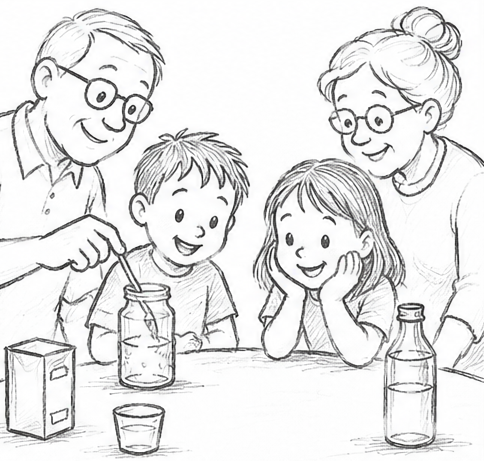
Grandparents and Little Ones
A science series for families — Kitchen science that surprises and is fun
Some of the best science in the world happens in ordinary kitchens, using ordinary things. A comb. A glass of water. A spoonful of bicarbonate of soda. The same ideas that explain how power stations work, how your microwave heats food, and why lightning flashes across the sky — all of them can be discovered right here at the kitchen table. Even if your grandchildren have done one or two before it will still be fun to reproduce them.
The experiments were put together with grandparents in mind — not because grandparents need simple science, but because a grandparent and grandchild together are one of the best learning partnerships there is. Grandparents have time, curiosity, and the wisdom to know that a good question matters more than a quick answer. Little ones have wonder, and absolutely no fear of being wrong.
The experiments don’t need special equipment. There is no standing over a stove or boiling a kettle and can be done comfortably seated at a kitchen table. All that is needed is curious grandchildren and supportive adults. Adult supervision is required.
These experiments are intended to stimulate an interest in STEM subjects and have in common the fact that they are all about atoms. A brief explanation of atoms is here.
- Water in the microwave — atoms move, movement makes heat, heat makes steam
- The magic comb — atoms have parts, and those parts can be pushed around
- The volcano in a glass — atoms swap partners and become something completely new
By the end of the three experiments, your little one will have a feel for how atoms behave that most adults never properly acquire — and they will have learned it by doing, not by sitting still and listening. That is exactly how science is supposed to work.
Start anywhere. Ask everything. There are no wrong questions.
Experiment 1: Water in the Microwave
https://standingtall.co.za/kitchen-science-water-in-the-microwave/
Experiment 2: Static Electricity – the Magic Comb
https://standingtall.co.za/kitchen-science-the-magic-comb/
It needs a dry environment to work. It works less well on a damp or humid day. A dry environment to work is needed
Experiment 3: A volcano in a glass
https://standingtall.co.za/kitchen-science-the-volcano-in-a-glass/
Experiment 4: Build a volcano – takes a little time over several days
https://standingtall.co.za/kitchen-science-4-build-a-volcano/
Experiment 5: The sleeping bean (for very little ones)
https://standingtall.co.za/kitchen-science-the-waking-up-bean/